 Sir Auditor Uviesherhe
A strong UTME result can open the door to screening, but it doesn’t tell you where you stand for admission. Your JAMB aggregate score is often the figure a university uses to rank eligible candidates for a course.
The catch is that Nigerian universities don’t follow one national calculation method. A score of 270 can produce different aggregates at different schools, because each institution sets its own weights for UTME, Post-UTME, and sometimes O’level grades.
Start with the school’s current admission notice, then calculate only with its published formula.
Start with the scores you actually have
Before reaching for a calculator, separate the scores and documents involved. Mixing them up is the fastest way to get a misleading aggregate.
Your UTME score is out of 400
JAMB gives your UTME result as a total out of 400. That is your raw score, not a percentage and not your admission aggregate.
For example, a UTME score of 280 means:
280 out of 400
A university may convert that 280 into 35, 42, 50, or another weighted value. The result depends on the formula in its screening notice.
Meeting JAMB’s national minimum tolerable score also doesn’t mean automatic admission. For the 2026 cycle, universities set their own screening eligibility and departmental standards above the national floor. Check the JAMB admission FAQ alongside your chosen university’s notice.
Your Post-UTME score may be out of 100
Where a school conducts a Post-UTME test, the result is often marked over 100. Some schools run an online screening instead of an examination. Others use a points system that includes your O’level grades.
Do not use a score from a practice test, a WhatsApp message, or an old admission portal screenshot. Use the result shown on the university’s official screening portal or in its published notice.

How a JAMB aggregate score is built
A JAMB aggregate score combines selected admission components into one figure, usually out of 100. The components and their weights come from the university, not from JAMB’s UTME result slip.
Many students learn one formula and apply it everywhere. That mistake can shift an aggregate by several points.
The common 50-50 model
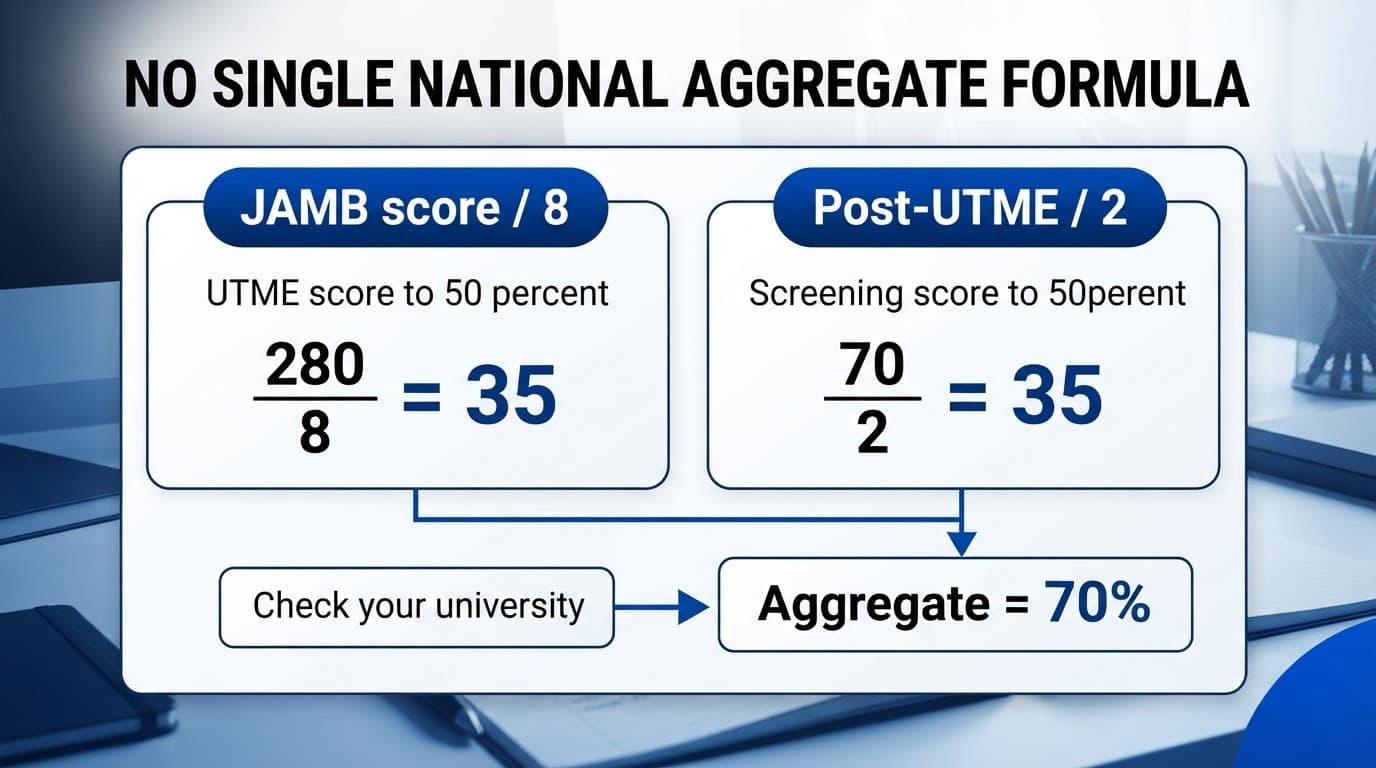
Some institutions give UTME 50 points and Post-UTME 50 points. Under this method, UTME is first reduced from 400 to 50.
The calculation is:
UTME contribution = UTME score / 8
Post-UTME contribution = Post-UTME score / 2
Aggregate = UTME contribution + Post-UTME contribution
For example, a candidate with 280 in UTME and 70 in Post-UTME gets:
UTME: 280 / 8 = 35
Post-UTME: 70 / 2 = 35
Aggregate: 35 + 35 = 70
The final aggregate is 70.00 out of 100.
Other schools include O’level performance
A university may give points for five relevant O’level subjects. That system can place weight on UTME, screening, and grades.
The University of Ilorin’s published 2025/2026 pre-admission notice, for instance, stated a 50 percent UTME component, 30 percent screening component, and 20 percent for five relevant O’level grades. That is a useful reminder that a formula can include more than two scores, but candidates should wait for the current notice before applying any method. Read the University of Ilorin screening announcement for the published breakdown.
An aggregate only has meaning beside the exact course, university, admission year, and candidate category it applies to.
Calculate a 50-50 aggregate step by step
The 50-50 approach is easy to calculate once you know why each number changes. UTME moves from a 400-point scale to a 50-point scale. Post-UTME moves from a 100-point scale to a 50-point scale.
Worked example: UTME 267 and Post-UTME 74
Use the formula exactly as published:
UTME contribution = 267 / 8
UTME contribution = 33.375


Post-UTME contribution = 74 / 2
Post-UTME contribution = 37


Aggregate = 33.375 + 37
Aggregate = 70.375
The candidate’s aggregate is 70.38, if the school rounds to two decimal places.
Do not round 33.375 to 33 before adding it to 37 unless the university instructs candidates to use whole numbers. Early rounding can change your position when many candidates have close scores.
Use percentage conversion when division is unclear
The same result can be calculated with percentages:
UTME percentage = 267 / 400 x 100 = 66.75%
50% of UTME score = 66.75 x 0.5 = 33.375


Post-UTME percentage = 74 / 100 x 100 = 74%
50% of Post-UTME score = 74 x 0.5 = 37


Aggregate = 33.375 + 37 = 70.375
Both methods give the same answer. Dividing UTME by 8 and Post-UTME by 2 is only a shortcut for this particular 50-50 model.
Work out 60-40 and three-part formulas
Some universities award more marks to UTME. Others reserve a portion of the aggregate for O’level grades. The mathematics is still simple, but the shortcuts change.
A 60 percent UTME and 40 percent Post-UTME formula
For a 60-40 formula, calculate each component from its original scale:
UTME contribution = UTME score / 400 x 60
Post-UTME contribution = Post-UTME score / 100 x 40
Aggregate = both contributions added together
Suppose a candidate has 280 in UTME and 65 in Post-UTME:
UTME: 280 / 400 x 60 = 42
Post-UTME: 65 / 100 x 40 = 26
Aggregate: 42 + 26 = 68
The aggregate is 68.00 out of 100.
Notice that dividing 280 by 8 would be wrong here. That gives 35, which belongs to a 50-point UTME weighting.
A 50-30-20 formula with O’level points
A three-part formula could allocate 50 points to UTME, 30 to screening, and 20 to O’level results. The university’s grade table decides the O’level points.
Assume a candidate has 280 UTME, 70 Post-UTME, and 16 out of 20 O’level points:
UTME: 280 / 400 x 50 = 35
Post-UTME: 70 / 100 x 30 = 21
O'level: 16


Aggregate: 35 + 21 + 16 = 72
That candidate’s aggregate is 72.00 out of 100. Do not invent the 16-point O’level value. Take it from the institution’s grade conversion table.
Treat O’level grades as admission data
Your SSCE result does more than show that you have five credits. In some admission systems, grades add numerical points to your aggregate.
Relevant subjects matter more than total credits
A university usually looks at five subjects that match your proposed course. English Language and Mathematics often matter, but course requirements vary.
For Medicine, Pharmacy, Engineering, Law, Accounting, Mass Communication, and other courses, confirm the approved subjects before calculating points. A credit in an unrelated subject may not replace a required one.
Federal University of Health Sciences, Ila-Orangun provides an example of a published grade-point method where five subjects can total up to 30 points. Its admission guidance and aggregate example shows why candidates must use a school’s own table rather than a social-media conversion chart.
Check the number of sittings
Some institutions accept one or two sittings, while particular programmes may set tighter rules. A 2026/2027 notice from Tai Solarin University of Education states that candidates need five relevant O’level credits in no more than two sittings. See the TASUED 2026/2027 screening requirements before assuming your combination qualifies.
If a school accepts two sittings, it may still calculate points differently for each sitting arrangement. Read the wording carefully.
Verify the 2026 university notice first
An aggregate is only an estimate until your university publishes its screening rules. Admission notices can change between sessions, even where the institution used the same method for years.
Look for the official 2026/2027 screening page
Use the university website, not a blog summary. Search for the current Post-UTME or admission screening announcement, then save a copy or take a screenshot with the publication date.
For example, the University of Nigeria, Nsukka 2026/2027 screening notice is a better starting point than an unverified calculator. The University of Lagos also states in its 2026/2027 Post-UTME notice that eligible UTME candidates must have selected UNILAG as first choice and scored at least 200.
Eligibility is separate from competitiveness. Clearing a 200-point screening threshold does not predict the aggregate needed for a course with many qualified applicants.
Confirm your admission category
UTME and Direct Entry candidates don’t always follow the same screening route. Direct Entry applicants may enter 200 level with approved qualifications such as ND, NCE, IJMB, or A-level credentials, subject to the institution’s rules.
Also confirm your catchment area status, programme choice, subject combination, and uploaded O’level result. A correct JAMB aggregate score cannot fix an incorrect course requirement or an unuploaded result.
Avoid the mistakes that distort aggregates
Most errors come from applying a familiar formula instead of the published one. A few minutes of checking can save weeks of false hope.
Use this quick verification checklist before relying on a figure:
- Confirm that your UTME score is the total out of 400 shown on your JAMB result.
- Check whether your university uses Post-UTME, online screening, O’level points, or a combination.
- Copy the percentage weights exactly, including any separate O’level component.
- Use only five subjects listed as relevant for your course.
- Keep decimal places until the final step, then follow the school’s rounding method.
- Check the current admission session and whether first-choice status is required.
- Compare your estimate with the official departmental cut-off only after the school publishes it.
Be cautious with claims such as “your aggregate is enough for admission.” Departments can have different cut-offs, quotas, and candidate pools. An aggregate helps you judge your position, but it cannot promise an offer.
Final thoughts on your admission aggregate
Your JAMB aggregate score is a practical planning tool, not a national fixed formula. Calculate it only after you confirm the current method from your chosen university.
Keep your UTME result, O’level details, screening score, and official notice in one place. Accurate inputs produce an honest estimate, and an honest estimate helps you make better admission decisions.







Add comment